
Loading...
For Research Use Only — Not for human consumption
Manufactured in the USAIndependently Batch TestedFast & Secure ShippingCompetitive PricingDedicated Support

This site sells research materials to qualified buyers.
For in vitro laboratory research only.
By entering, you agree to our and .
Order now — ships same day
These products are for laboratory research only and not intended for medical use. They must be handled by qualified professionals in controlled laboratory environments. This compound has not been evaluated by the FDA and is not approved for human or veterinary use.
Third-party tested for purity, identity, and quantity.
Our Melanotan II is manufactured to ≥98% purity as verified by high-performance liquid chromatography (HPLC). A certificate of analysis (CoA) with mass spectrometry confirmation is available for each lot upon request.
MT-II is a non-selective melanocortin receptor agonist with documented binding activity at MC1R, MC3R, MC4R, and MC5R in pharmacological studies. It does not significantly bind MC2R (the ACTH receptor). Its relative affinity profile makes it a commonly used pharmacological tool for comparing receptor subtype-mediated signaling in transfected cell lines and tissue preparations.
Preclinical and in vitro research involving MT-II has spanned melanocortin receptor pharmacology, hypothalamic signaling, and melanocyte cell biology. It has been employed as a reference agonist in competitive binding assays, receptor internalization studies, and cAMP accumulation assays across multiple cell-based model systems.
No. Melanotan II is supplied strictly for laboratory and preclinical research purposes only. It is not approved for human use by any regulatory authority, and this product is not intended for clinical, therapeutic, or veterinary application. Researchers must comply with all applicable institutional and regulatory guidelines governing peptide research compounds.
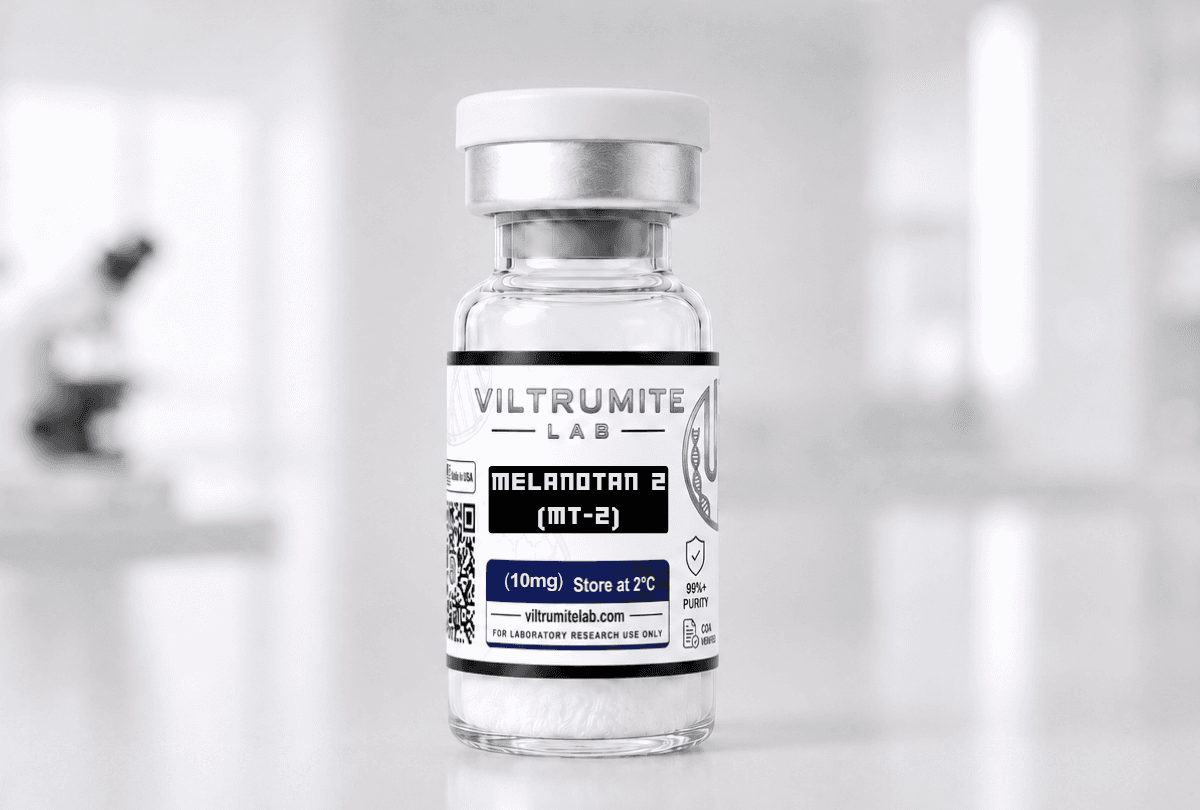
Melanotan II (MT-II; also referred to as Melanotan 2) is a cyclic synthetic analog of the endogenous neuropeptide α-melanocyte-stimulating hormone (α-MSH), with the core Ac-Nle-cyclo[Asp-His-D-Phe-Arg-Trp-Lys]-NH₂ sequence. Its cyclic structure is studied in relation to receptor binding affinity and metabolic stability compared with the native linear peptide. It belongs to the melanocortin peptide class and functions as a non-selective melanocortin receptor agonist. Research into MT-II includes receptor subtype pharmacology, central melanocortin signaling, and hypothalamic neuroendocrine circuitry in preclinical models. Its cyclized structure and incorporation of D-Phe support structure–activity investigations of melanocortin receptor binding and signaling in laboratory settings.